
fajsdfjash ddsa dsa as sa sad sda sadfjsadjfl jsadjk fjasdlkfjaskdfdklsaj klf
jsadj
asjdklj falsdjf
jaklj

Products
Why ±0.1°C Matters in Optical Lens Injection Molding
09 September 2026
Author:AODE
share:


As smartphone cameras, automotive cameras, and security surveillance systems move toward higher resolution, smaller dimensions, and greater imaging precision, temperature stability is becoming increasingly important in optical lens injection molding.
For optical materials such as PMMA, COP, and COC, mold temperature affects not only the molding process, but also birefringence, internal stress, surface accuracy, and batch consistency. Compared with conventional ±1°C temperature control, ±0.1°C high-precision mold temperature control is becoming an important process condition for some high-precision camera lens applications.
This article looks at the impact of temperature fluctuations, the value of ±0.1°C control, and the different temperature-control requirements of smartphone, automotive, and security camera lenses.
Why Is Optical Lens Injection Molding So Sensitive to Mold Temperature?
Compared with conventional plastic parts, optical lens injection molding requires more than acceptable dimensions and appearance. Light transmission, surface accuracy, and optical consistency must also be controlled.
Mold temperature directly affects lens cooling and shrinkage. Even when other process parameters remain unchanged, changes in mold temperature can still lead to differences in final lens performance.
This is particularly important for PMMA, COP, and COC. In COP injection molding and other high-precision lens applications, the material itself may offer good transparency and optical performance, but reproducing these properties consistently requires the mold to maintain a stable and repeatable thermal condition.
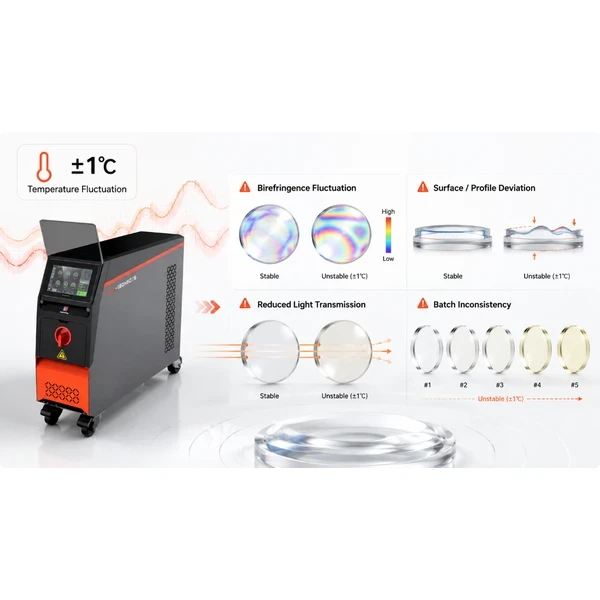
How Can ±1°C Temperature Fluctuations Affect Optical Lenses?
For conventional injection-molded parts, a ±1°C mold temperature variation may not necessarily cause obvious defects. In high-precision optical lens injection molding, however, lenses are more sensitive to cooling conditions and internal stress.
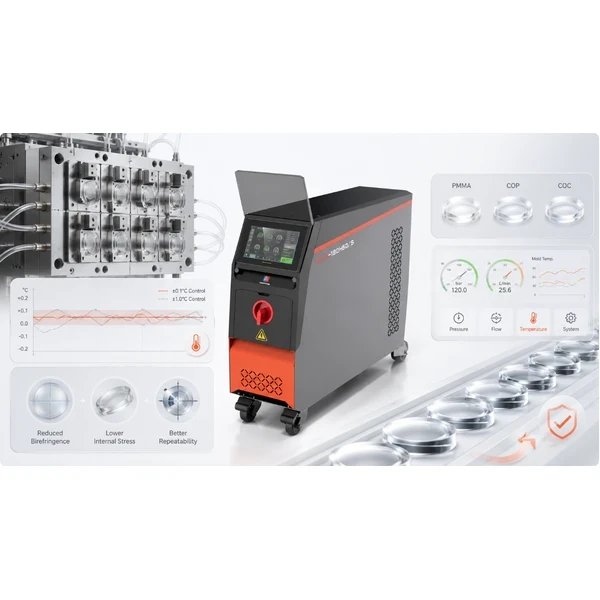
1. Birefringence Fluctuation
Changes in mold temperature can alter the cooling rate and stress-relief process in different areas of the lens, resulting in differences in molecular orientation and residual stress. For PMMA, COP, and COC, these differences may appear in birefringence inspection results and make birefringence control more difficult.
2. Surface Profile and Dimensional Stability
Optical lenses have much stricter requirements for surface accuracy and dimensional tolerances than ordinary plastic parts. Local mold temperature differences or variations between molding cycles can change material shrinkage and increase variation in lens profile and dimensions, especially for small, high-precision lenses.
3. Light Transmission and Color
Optical materials have suitable processing temperature ranges. Continuous temperature overshoot, local overheating, or excessive exposure to high temperatures may accelerate thermal degradation and increase the risk of reduced light transmission or yellowing.
4. Batch Consistency
Producing one acceptable lens does not mean the same result can be maintained throughout continuous production. When mold temperature changes between cycles, birefringence, dimensions, and optical inspection data are also more likely to vary. In multi-lens assemblies used in smartphone and automotive cameras, these differences may accumulate during assembly.
The issue with ±1°C control is therefore not that it will always produce defective parts, but that for increasingly precise optical lenses, it may leave too much room for thermal variation. This is why some high-precision camera lens production is moving toward ±0.1°C temperature control.
Why Is ±0.1°C Temperature Control More Suitable for High-Precision Camera Lens Injection Molding?
For high-precision camera lens injection molding, ±0.1°C control is not simply about achieving a smaller temperature number. Its value lies in keeping the mold closer to the set temperature during continuous production.
For PMMA, COP, and COC, this helps reduce the influence of temperature changes on cooling and stress relief and makes molding conditions easier to maintain within a stable range.
1. Reduce Mold Temperature Drift
Even when injection speed, pressure, and holding time remain unchanged, changes in mold temperature between cycles can still affect lens cooling. ±0.1°C control can further reduce this variation and keep each molding cycle under more similar thermal conditions.
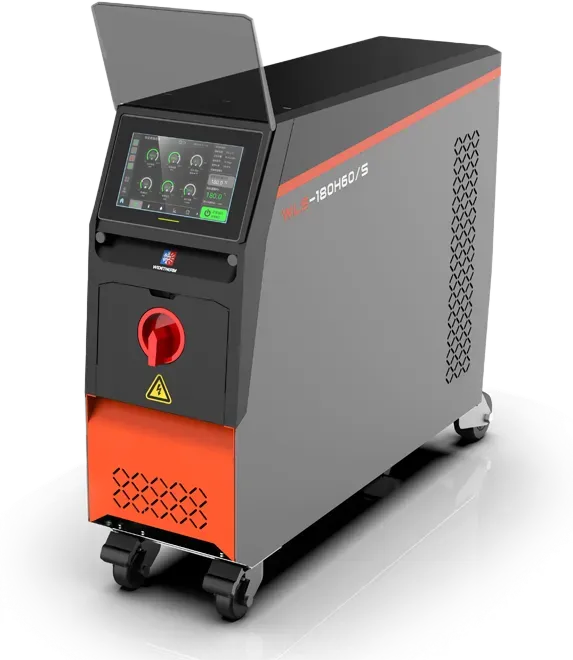
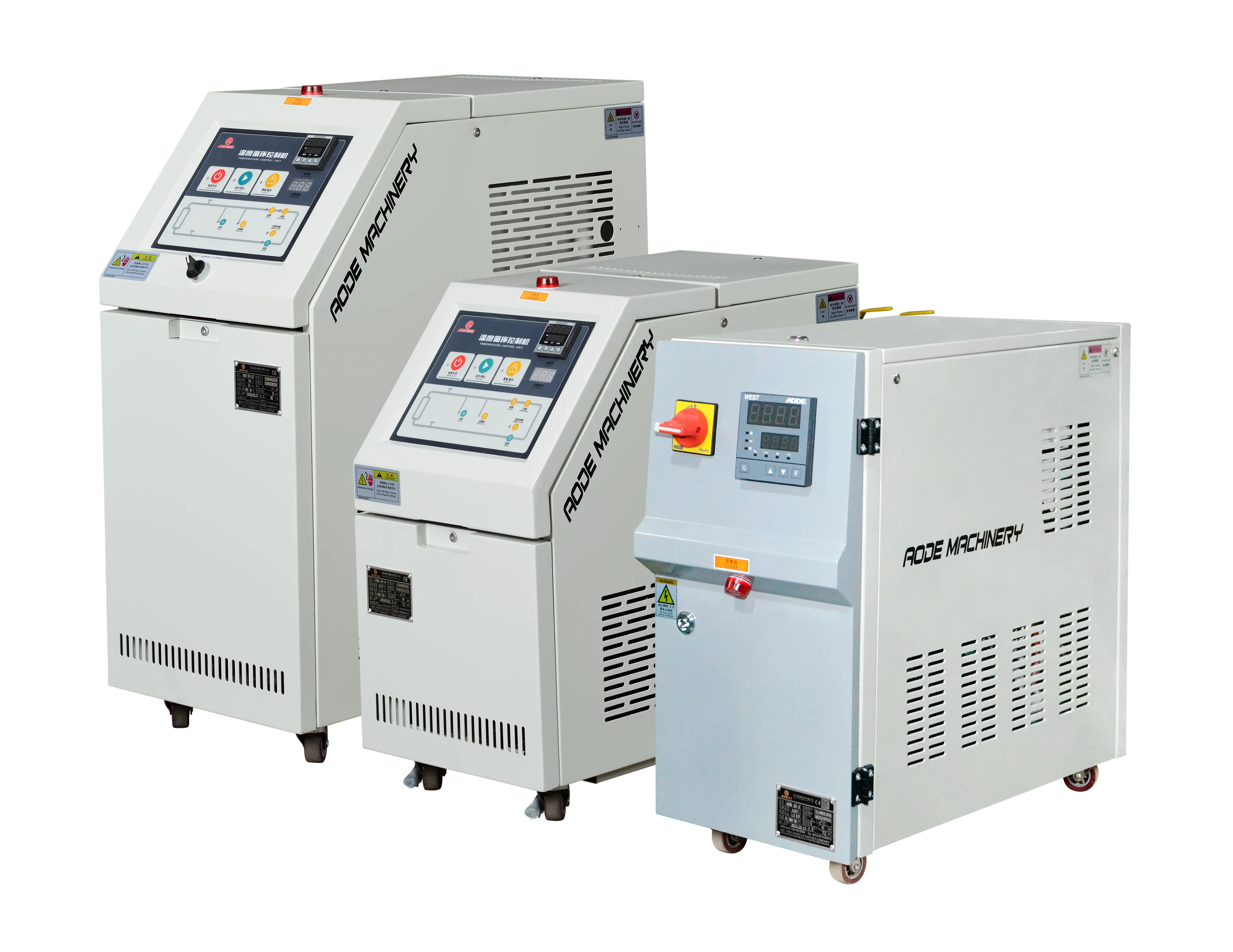
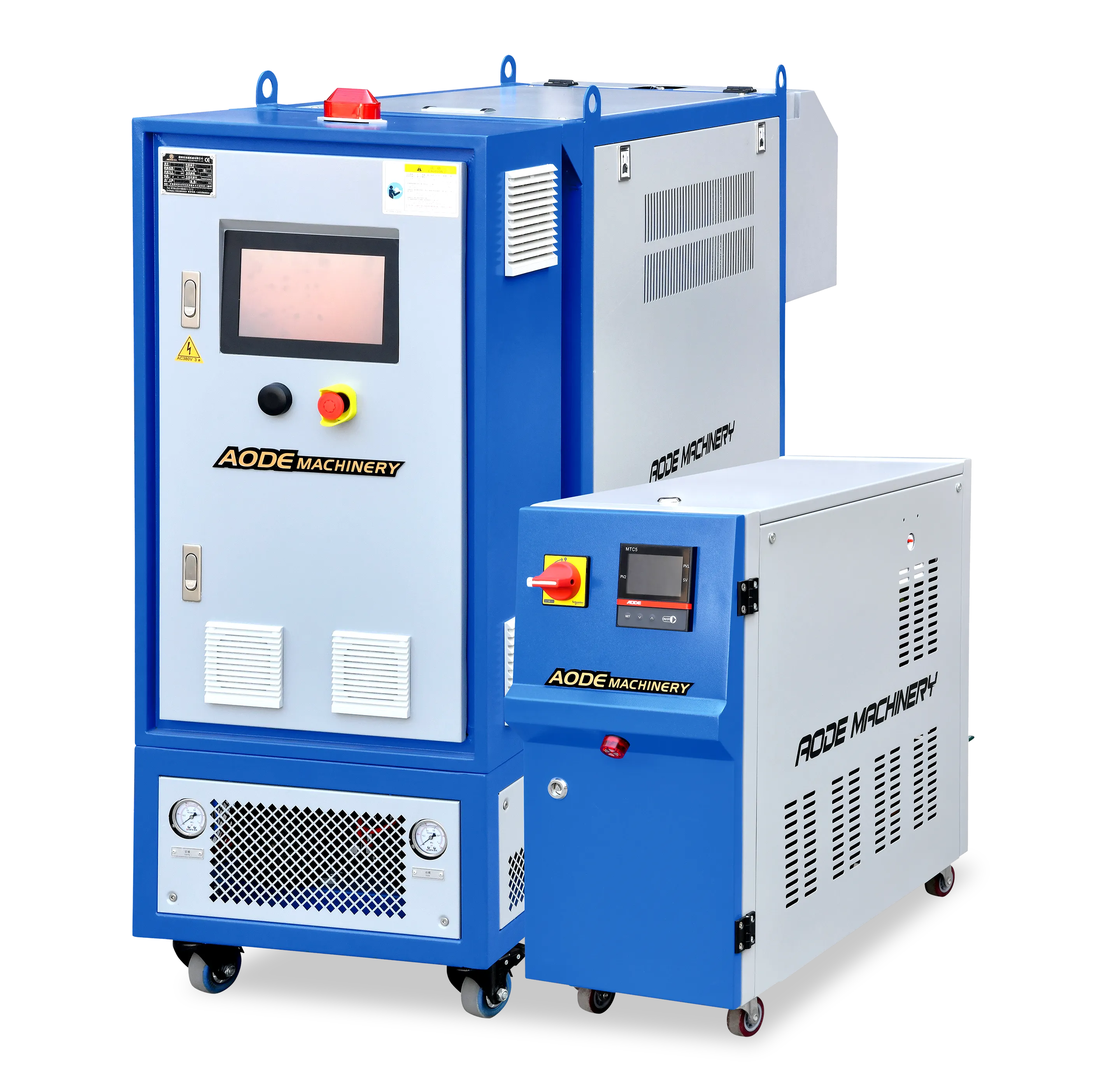
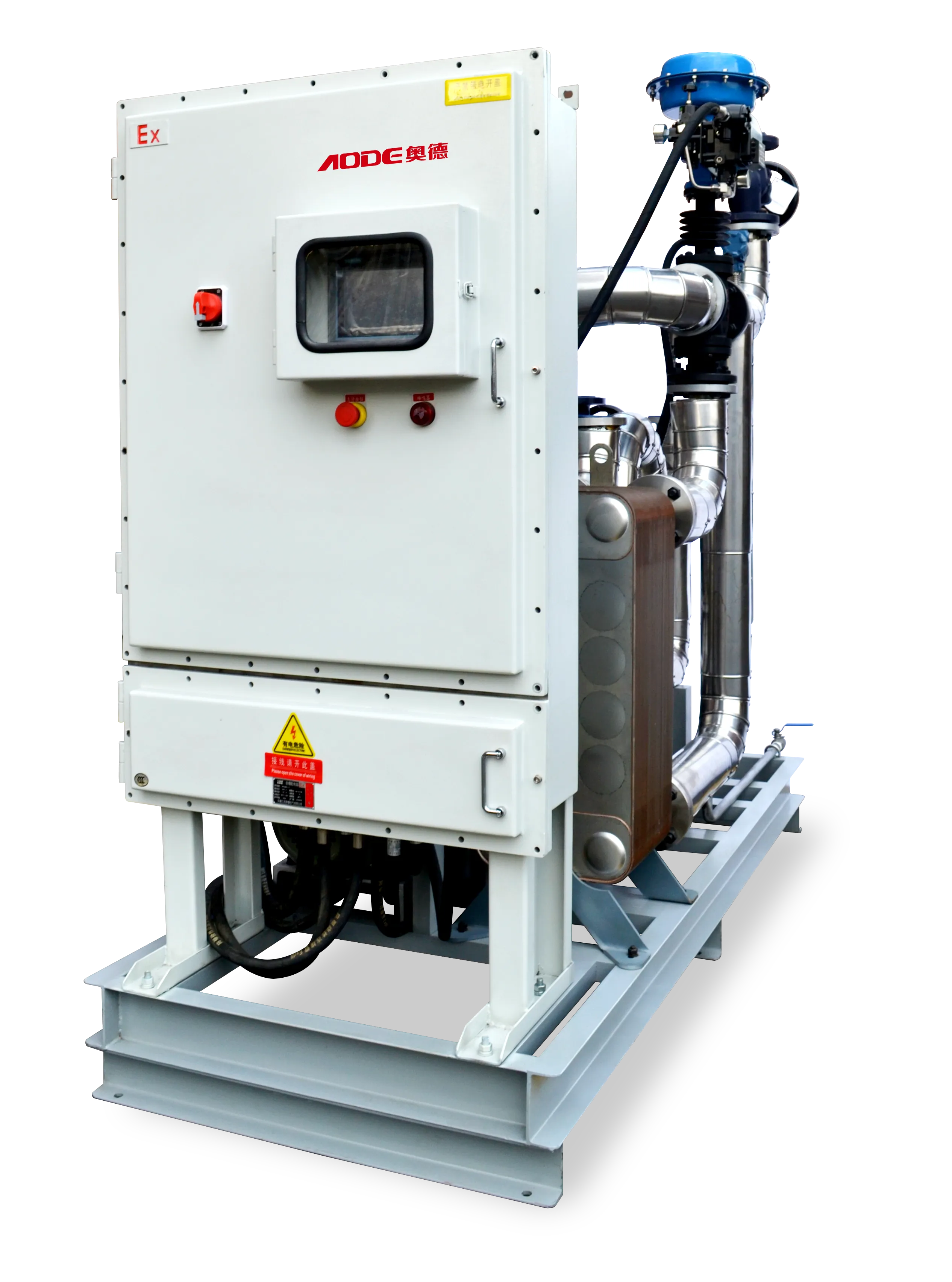
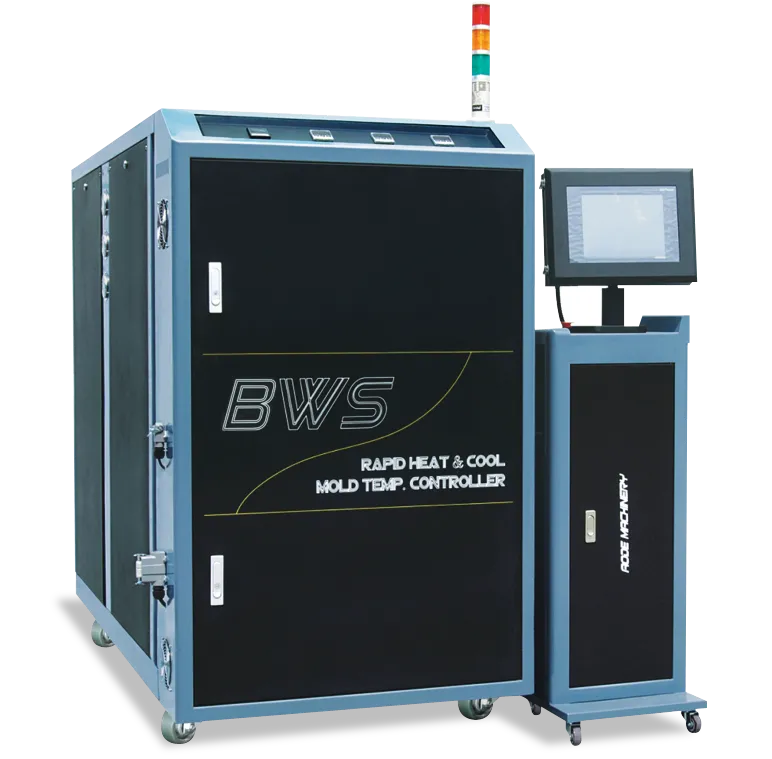
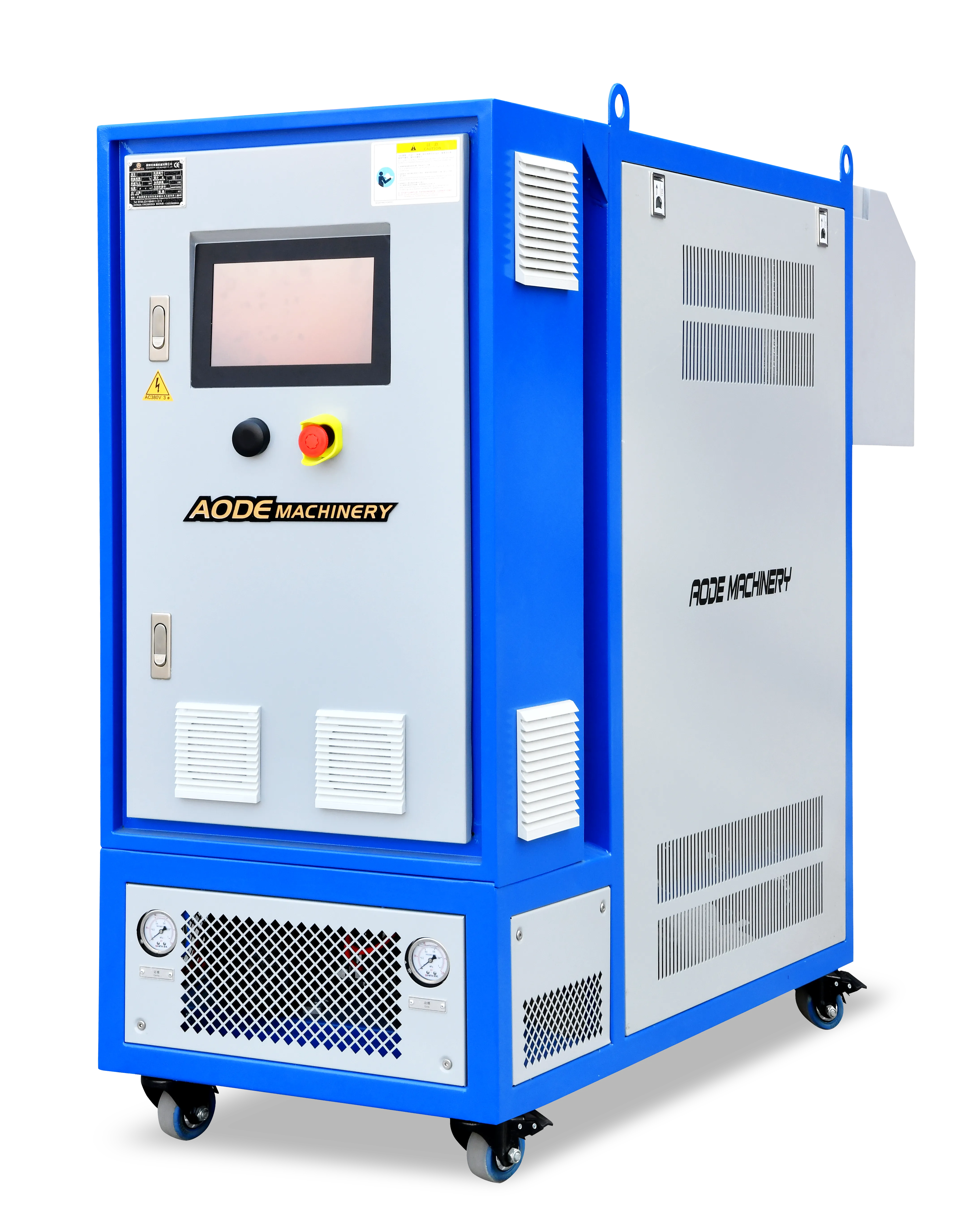
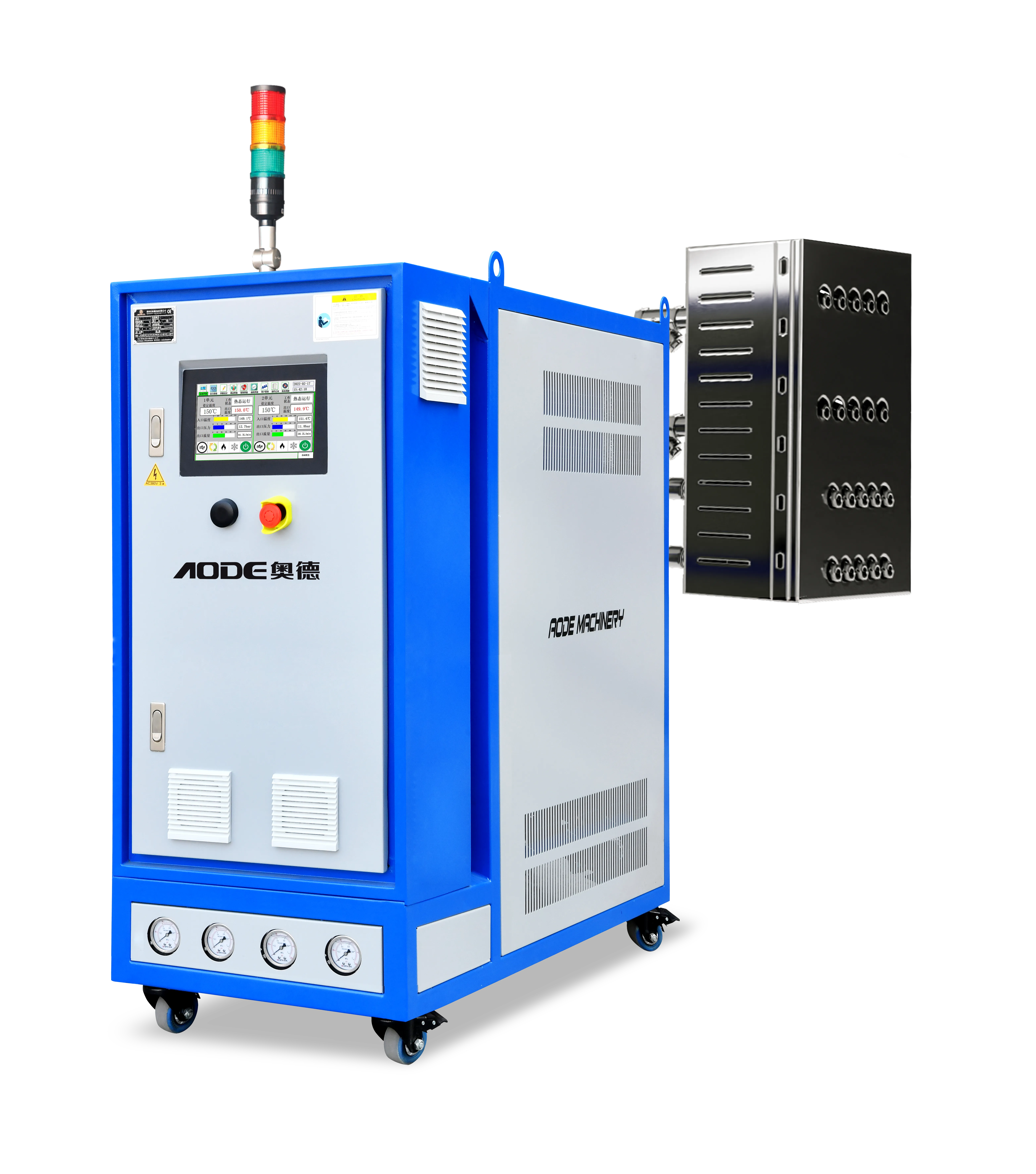
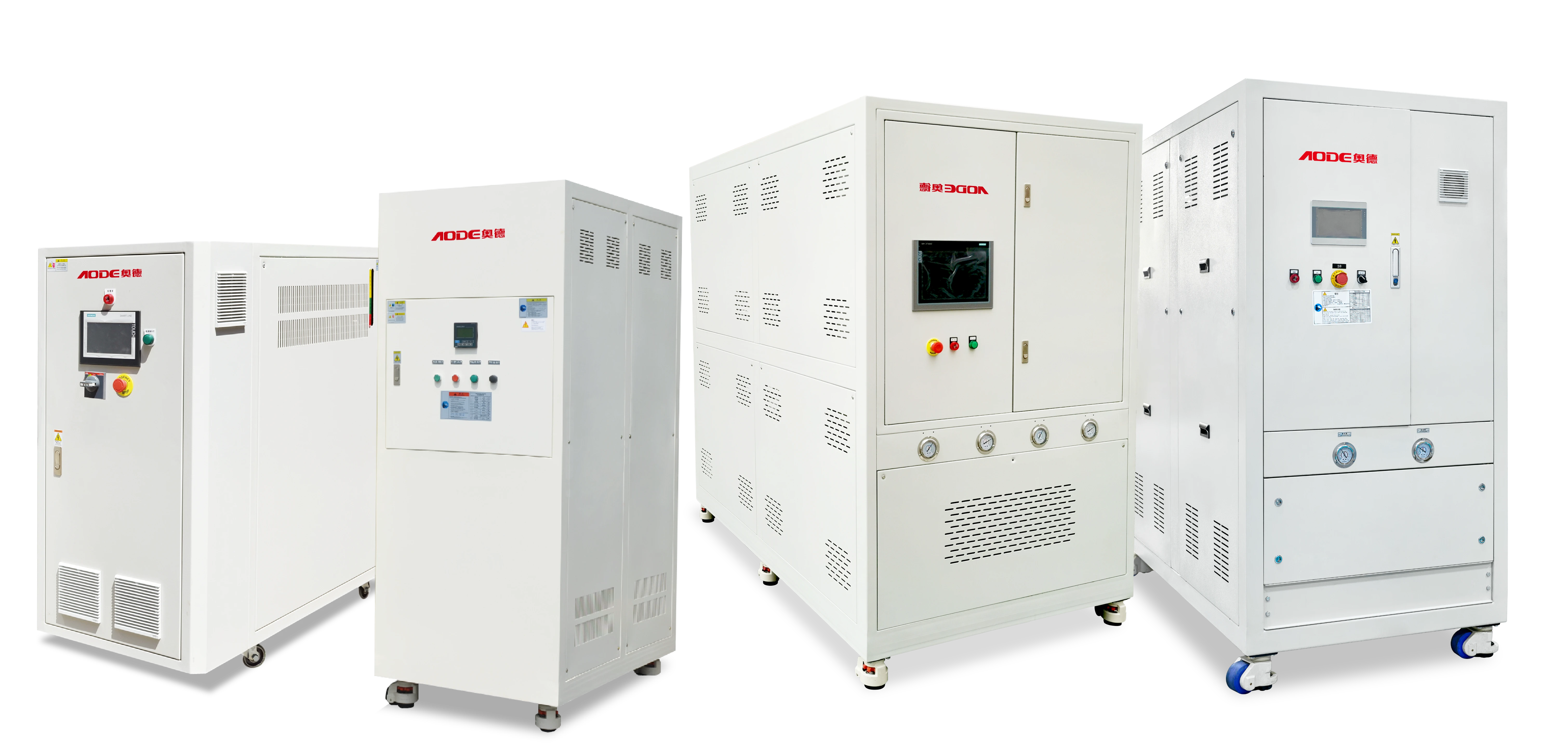
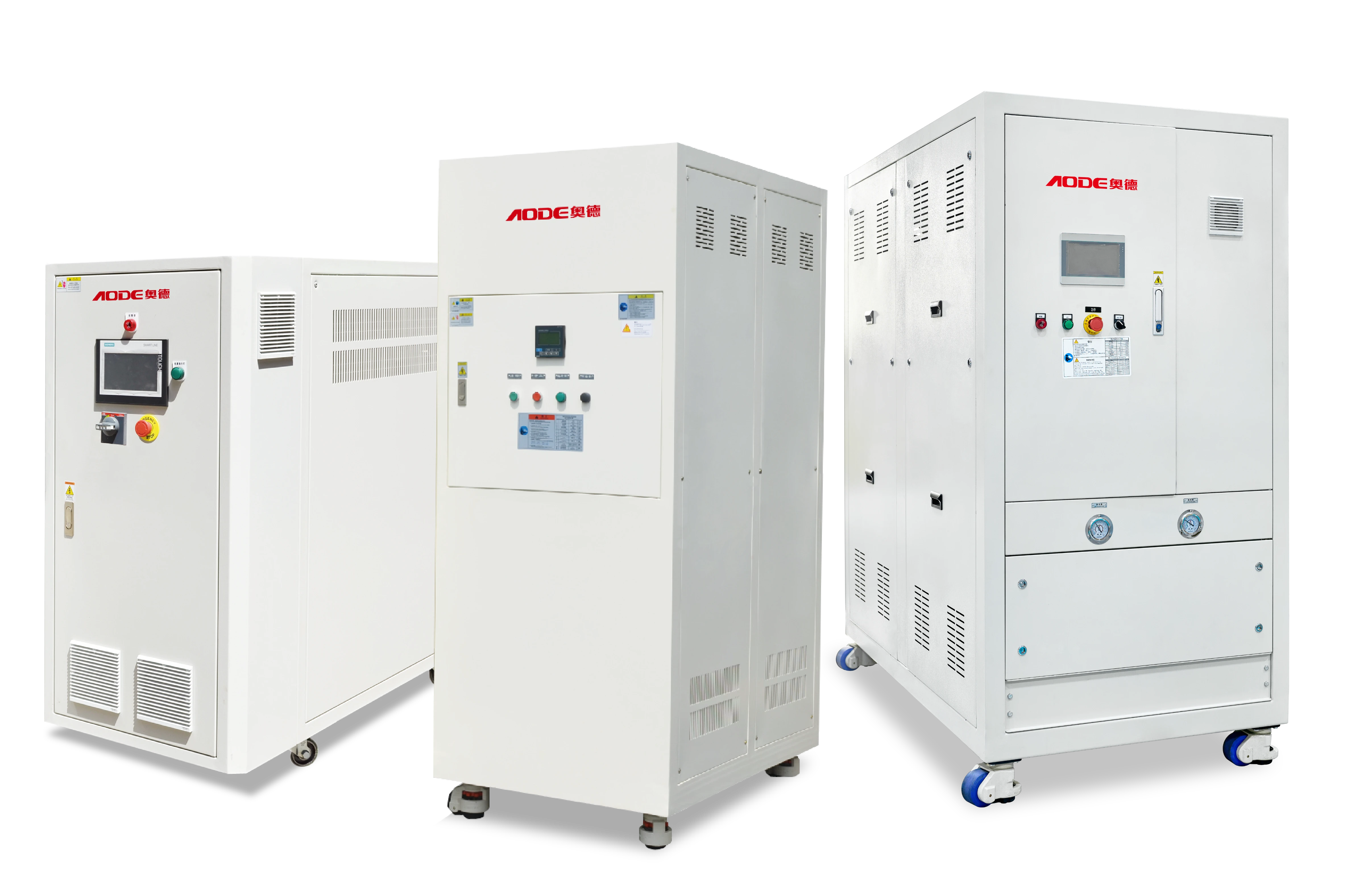
AODE high-precision mold temperature controllers use sensitive temperature feedback together with heating and cooling adjustment to reduce overshoot and long-term temperature drift. For precision lens production, reaching the set temperature is only the first step; keeping it stable is more important.
2. Reduce One Variable in Birefringence and Internal Stress Control
Birefringence control is also affected by material condition, injection speed, pressure, holding pressure, and mold structure. If mold temperature is unstable, it becomes more difficult to identify which factor is causing changes in inspection results.
Keeping mold temperature within a narrower range helps stabilize one important process condition. This gives engineers a clearer basis when adjusting injection parameters, analyzing residual stress, or troubleshooting birefringence problems, especially in precision COP and COC molding.
3. Multi-Cavity Molds Also Depend on Flow and Pressure
For multi-cavity camera lens molds, the challenge is not only the set temperature, but also whether heat exchange is uniform across different circuits. Insufficient flow or unsuitable pressure in one circuit can create different thermal conditions between cavities.
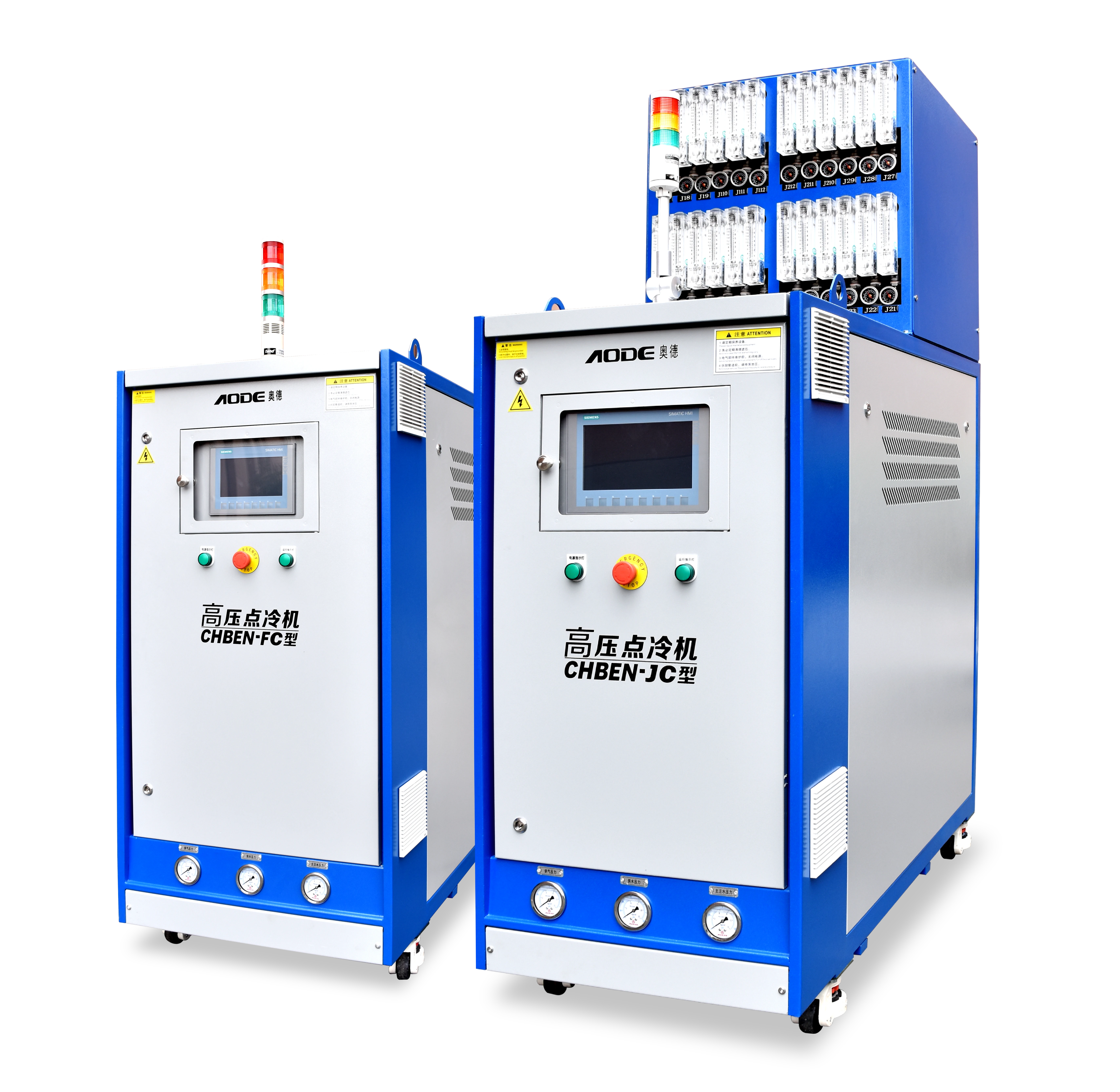
AODE considers mold circuit quantity, piping resistance, circulation flow, and pressure requirements together with ±0.1°C control. Temperature, flow, and pressure need to be properly matched for high-precision temperature control to work effectively on the mold.
4. Long-Term Continuous Production Requires Stable Control
High-precision lens production often runs continuously for several hours or longer. The key is whether the temperature-control system can remain stable under changing loads and continuous operation.
When mold temperature remains stable, engineers are less likely to repeatedly adjust process parameters because of temperature drift, and the production cycle is easier to maintain. This is especially important for mass-production applications such as smartphone, automotive, and security lenses.
How Do Temperature-Control Requirements Differ for Smartphone, Automotive, and Security Camera Lenses?
Although all three applications involve high-precision optical lens injection molding, their product dimensions, use requirements, and production methods are different.
| Application | Product Characteristics | Main Production Challenge | Temperature-Control Priority | AODE Solution Focus |
|---|---|---|---|---|
| Smartphone camera lenses | Small lenses, high precision, multi-lens assemblies | Tight dimensional and optical tolerances | High precision and fast response | ±0.1°C control matched to small precision molds and short molding cycles |
| Automotive camera lenses | Front-view, surround-view and ADAS applications | Long-term process and dimensional reliability | Continuous operating stability | Pump and heating/cooling capacity matched to mold resistance and sustained load |
| Security camera lenses | High-volume, long production runs | Maintaining yield across shifts and batches | Heat-transfer capacity and production efficiency | Balanced temperature, flow and pressure for continuous production |
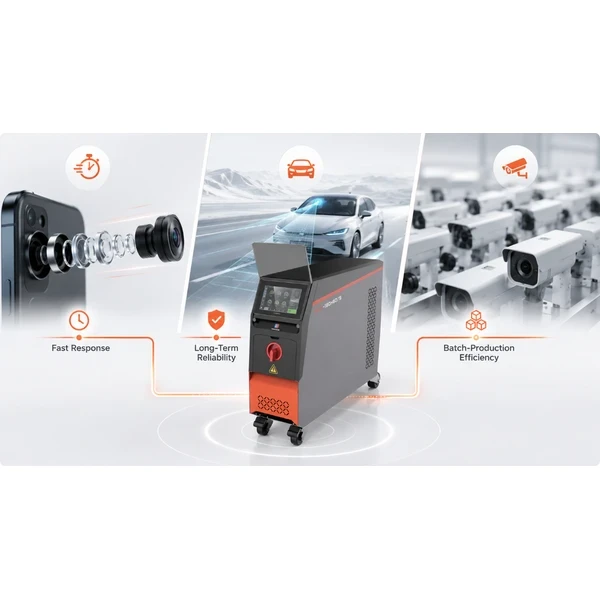
1. Smartphone Camera Lenses: Fast Response
Smartphone lenses are becoming smaller while imaging and assembly precision continue to increase. These short-cycle precision molds require a temperature-control system that can respond quickly to thermal load changes.
AODE high-precision mold temperature controllers combine ±0.1°C control with fast heating and cooling response, making them suitable for applications that require both short cycles and temperature repeatability.
2. Automotive Camera Lenses: Long-Term Reliability
Front-view, surround-view, and ADAS cameras place greater emphasis on long-term reliability. On the production side, the temperature-control system must also perform reliably during extended operation.
Automotive lens projects therefore need circulation pump capacity and heating and cooling capability matched to actual operating temperature, mold resistance, and continuous load. AODE focuses on system capacity and long-term operating performance in these applications.
3. Security Camera Lenses: Yield and Equipment Utilization
Security lenses are often produced in larger volumes, so temperature-control performance has a direct impact on production efficiency.
Waiting for temperature recovery, repeated adjustment, or uneven heat exchange between cavities can reduce equipment utilization and increase batch variation. Sufficient flow, pressure, and heat-transfer capacity help support long-term batch production and reduce downtime and rework.
The focus of ±0.1°C temperature control therefore differs by application: smartphone lenses emphasize response speed, automotive lenses emphasize continuous operating capability, and security lenses emphasize batch production efficiency.
Conclusion
For high-precision camera lenses, the value of ±0.1°C temperature control is not simply greater accuracy. It helps reduce temperature drift during continuous production and provides a more stable process basis for birefringence, dimensions, internal stress, and batch consistency.
AODE provides ±0.1°C high-precision mold temperature-control solutions for PMMA, COP, COC, and other optical lens injection molding applications, with configurations matched to the actual mold and production process.
If you are dealing with birefringence fluctuation, temperature differences between mold cavities, or inconsistent lens quality between batches, contact AODE for a high-precision temperature-control solution suited to your production process.
To see how AODE high-precision temperature-control technology supports demanding molding applications, read our article on why high-precision mold temperature controllers are used in precision injection molding.
 Back to List
Table of Contents
×
CONTACT US
Cookie Policy
We use cookies and other tracking technologies online. Please read our Cookie Policy, which is part of this Cookie Policy , and is incorporated herein by reference.

loading...