
fajsdfjash ddsa dsa as sa sad sda sadfjsadjfl jsadjk fjasdlkfjaskdfdklsaj klf
jsadj
asjdklj falsdjf
jaklj

Products
Air-Cooled vs Water-Cooled Chillers: Key Differences, Pros, and Best Applications
24 April 2026
Author:
share:


This article compares the key characteristics, advantages, and best-use scenarios of air-cooled and water-cooled chillers to help buyers select the most suitable solution for their production environment.
What is an industrial chiller?
An industrial chiller is a machine specifically used to cool and control the temperature of industrial equipment and production processes. It can ensure that machines do not "overheat," thereby reducing cost losses, ensuring production stability, and guaranteeing that batch-produced products meet quality standards. According to the heat dissipation path, industrial chillers can be divided into air-cooled chillers, water-cooled chillers, and evaporatively cooled chillers. Although they all undertake the same basic function, they have significant differences in heat dissipation path and system design. This article mainly compares the differences between air-cooled and water-cooled industrial chillers, in preparation for selecting a suitable cooling system for specific factories, processes, and so on.
If you want to learn more in detail about the working principle of industrial chillers, please click the article below to read:
What Is an Industrial Chiller A Complete Guide to Types, Working Principles, and Applications
Air-Cooled vs. Water-Cooled Chillers: The Real Differences
If you want to quickly understand the differences between these two machines, then first look at the table below for a quick comparison:
| Comparison Item | Air-Cooled Chiller | Water-Cooled Chiller |
| Heat Rejection Method | Dissipates heat through ambient air by means of condenser fans | Rejects heat through cooling water, usually used together with a cooling tower |
| Installation | Easier and faster to install | Requires an additional water system, with more installation work |
| Space Requirement | Suitable for sites without cooling tower infrastructure | Better suited for factories with dedicated utility space |
| Energy Efficiency | Usually lower under high ambient temperatures or continuous heavy-duty use | Usually more efficient for large-capacity and long-running applications |
| Operating Cost | Lower initial investment, but energy consumption costs may be higher in the long run | Higher initial setup cost, but lower long-term operating cost in many large systems |
| Maintenance | Daily maintenance is simpler, mainly coil and fan cleaning | Requires water treatment, condenser cleaning, and cooling tower maintenance |
| Noise Level | Usually higher because of condenser fans | Usually quieter at the unit level |
After reading this simple table, you will have a preliminary understanding of these two products. Next is a detailed explanation of the differences between air-cooled and water-cooled industrial chillers:
1.Heat rejection method, installation, and space requirements
The most fundamental difference between air-cooled industrial chillers and water-cooled chillers lies in their heat rejection method. The operating method of a chiller is: when the equipment generates heat, the cooling water "absorbs" the heat, and then inside the chiller, this heat is transferred to the refrigerant, and the refrigerant then expels the heat to the outside. In fact, the difference between air-cooled and water-cooled is not whether both can cool in the earlier stage, but whether in the final heat rejection step the heat is discharged by air, or whether this heat is first "handed over" to water and then discharged.
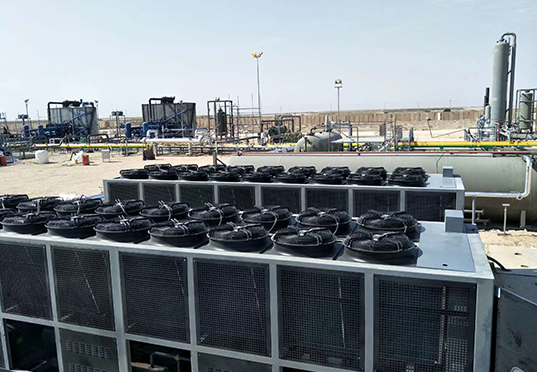
In the condenser step, an air-cooled industrial chiller relies on fans blowing across the condenser coil, and then directly discharges the heat into the surrounding air. Therefore, it usually does not require a cooling tower, nor does it need an additional condenser water system. Installation is often simpler, and the space requirement is not large, making it suitable for small and medium-sized factories.
A water-cooled chiller first transfers this heat from the refrigerant to water, and then the heat is discharged into the air through a cooling tower or dry cooler. Compared with an air-cooled chiller, a water-cooled chiller has an additional condenser water loop, pumps, valves, and cooling tower, so whether in terms of installation method or space requirements, water-cooled chillers are often more complex and have higher requirements than air-cooled ones. Therefore, water-cooled chillers are more suitable for large factories, central cooling systems, and so on.
2.Energy efficiency, operating cost, and continuous operation capability
Air-cooled industrial chillers rely heavily on ambient air to carry away the heat. Their condensing performance is more directly affected by outdoor or indoor air temperature. When the surrounding temperature rises, the industrial chiller must work harder to discharge the same amount of heat, which also directly affects later costs, such as reduced production efficiency, increased power consumption, and so on.
Water-cooled industrial chillers, however, usually operate under more stable heat rejection conditions. Compared with the ambient air relied on by air-cooled chillers, water can transfer heat more effectively. In large-capacity or continuous-operation applications, and without depending on the outside environment, they can maintain/improve the operating efficiency of the system. Because installation is more complex and site requirements are greater, factories that run for long hours and have high and stable cooling demand need to invest a large amount of cost in the early stage, but a great deal of energy can be saved in the later stage, which can offset the initial installation cost of the water-cooled system. Whether in terms of cost or continuous operation capability, water-cooled chillers can often perform better in the later stage.
3.Maintenance, noise, and service complexity
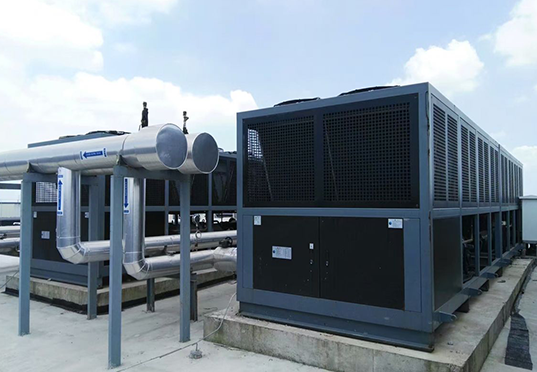
The overall structure of an air-cooled chiller is simpler than that of a water-cooled one. It does not rely on a cooling tower, condenser water, or a water treatment system. In daily operation, maintenance is relatively direct, mainly focusing on condenser coil cleaning, fan inspection, and so on. However, because the system exchanges heat directly with ambient air, its performance will be affected by dust, airflow conditions, and high-temperature environments. Air-cooled units rely more on condenser fans, so the noise at the unit level is usually more obvious.
The water side of a water-cooled chiller also needs to be managed, and it also involves more system-level maintenance. In addition to the refrigeration components, operators also need to monitor water quality, prevent scaling or fouling, and maintain pumps, pipelines, and equipment related to the cooling tower. Maintenance is also much more complicated than that of air-cooled units. The water-cooled unit itself is usually quieter, but you also need to consider peripheral equipment such as cooling towers. For large factories, in exchange for better energy efficiency performance and stronger long-term operating stability, this additional maintenance complexity is usually acceptable.
Key advantages of air-cooled and water-cooled chillers
In addition to comparing the differences between air-cooled and water-cooled chillers, we also need to know their key advantages. Below are the core advantages of these two types of industrial chillers:
1.Advantages of AODE air-cooled industrial chillers
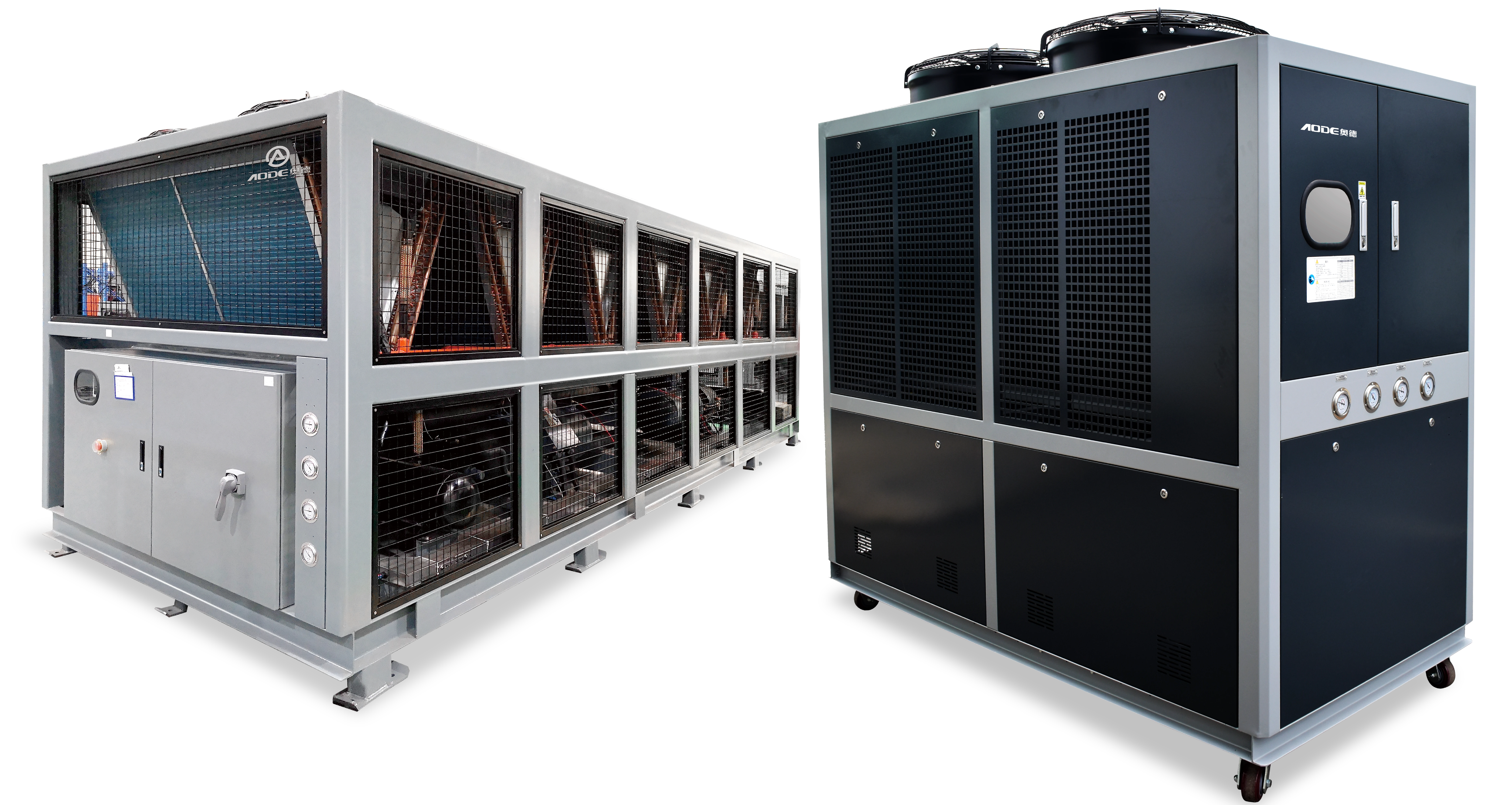
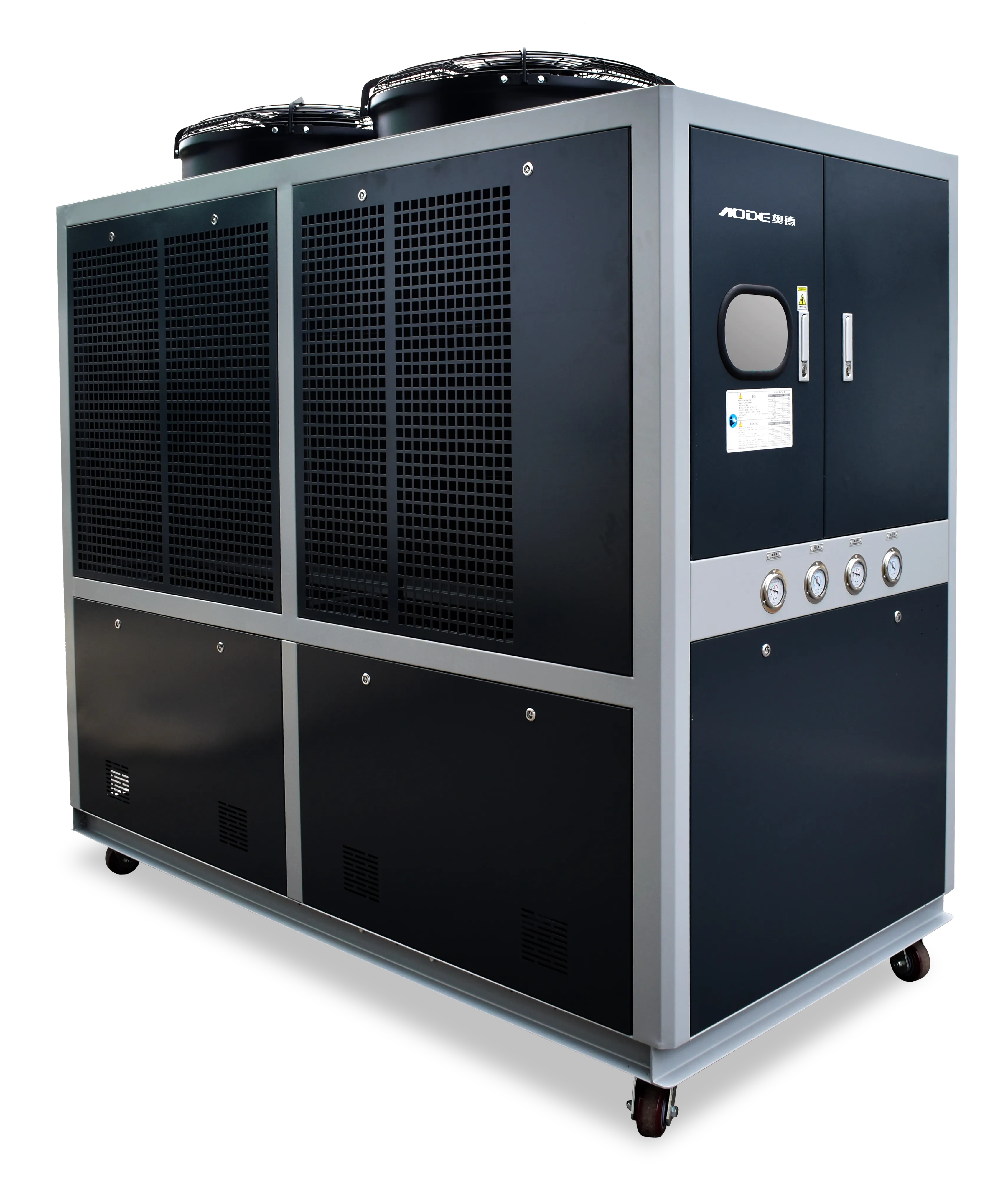
AODE's air-cooled industrial chillershave greater advantages in installation, as they do not require a cooling tower or a separate condenser water system, which makes them a practical choice for factories with limited utility conditions, retrofit projects, and standalone equipment.
Another advantage is their packaged and space-saving design, which helps simplify system integration. In addition, the cooling capacity range starts from 2.9 kW to 180 kW, making them suitable for small machines for small equipment, small production lines, standalone supporting applications, or retrofit projects, without matching an oversized unit from the very beginning.
2.Advantages of AODE water-cooled industrial chillers
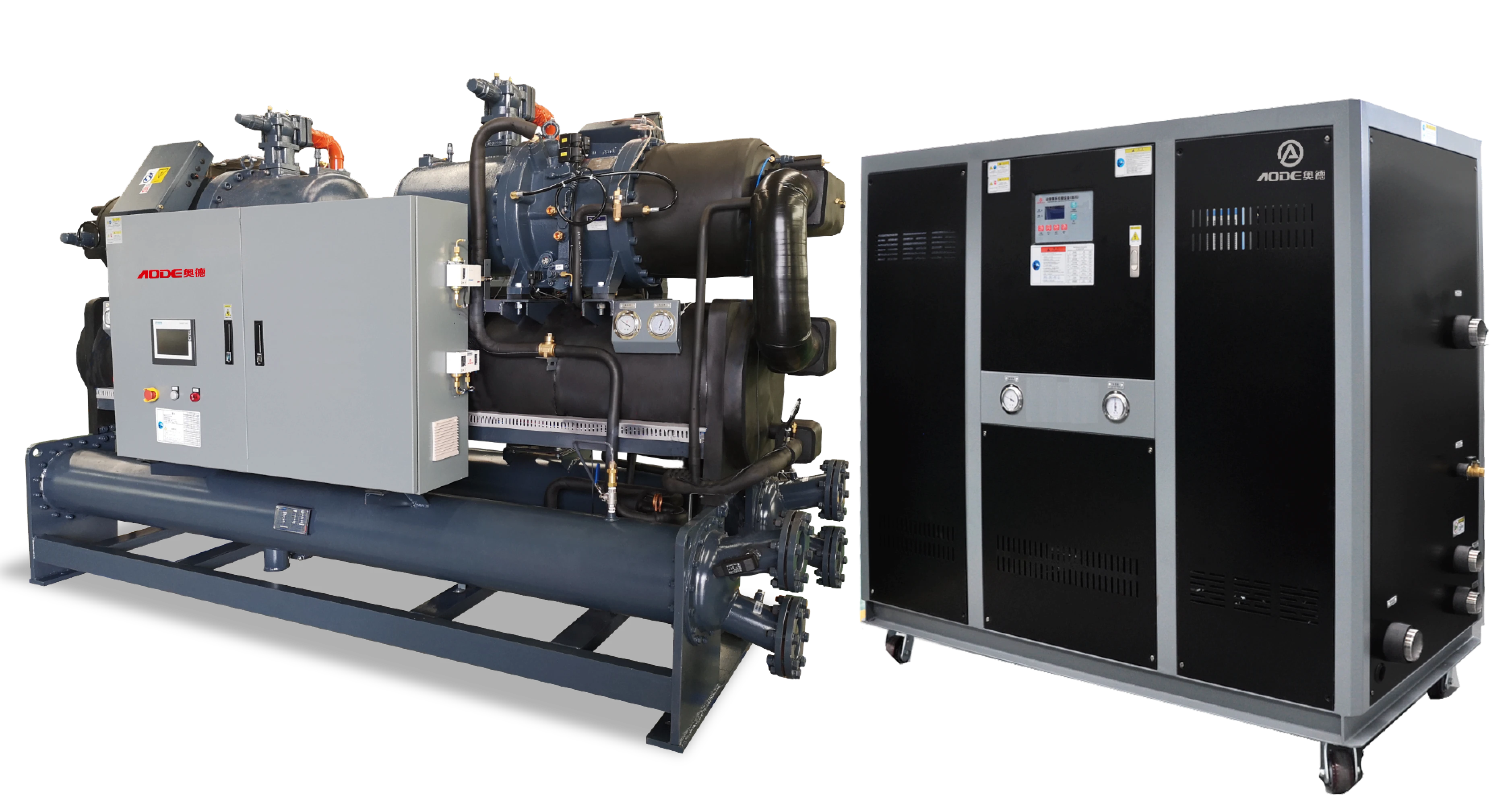
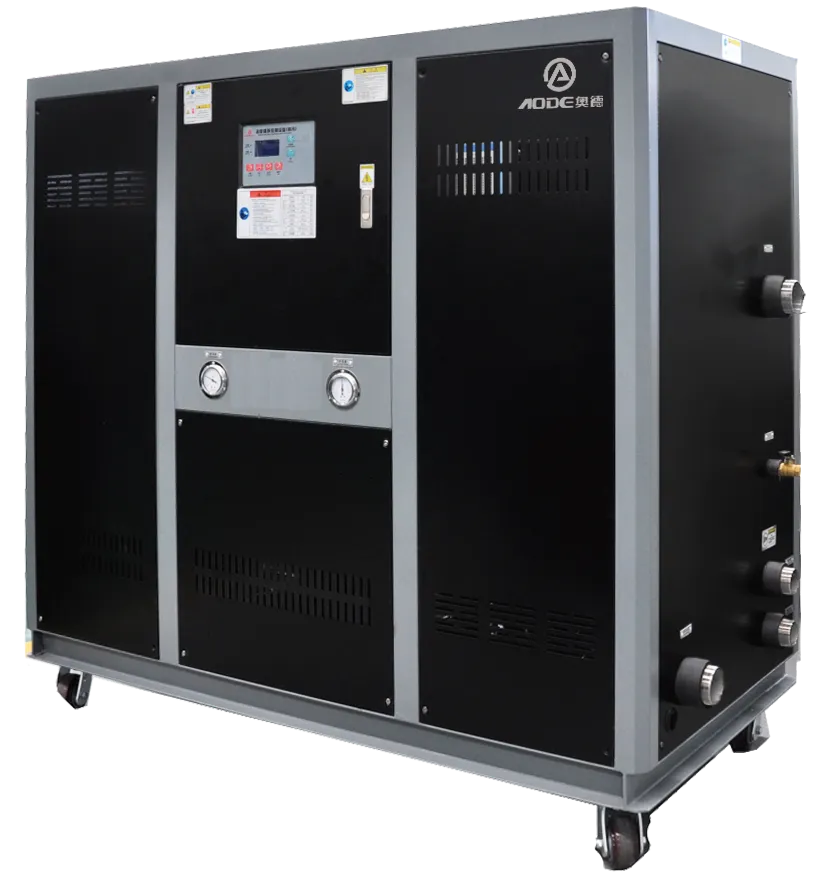
AODE water-cooled industrial chillers are more suitable for high-load, long-hour operation and scenarios with higher long-term energy efficiency requirements. Their cooling capacity covers about 15.3–192 kW and they use shell-and-tube condensers, making them more suitable for large factories, central cooling, or continuous production conditions. And their unique point is not on "easy installation," but on efficiency advantages under high loads, long-term operating stability, and greater suitability for large system expansion.
Best Applications by Production Environment
The most suitable industrial chiller system applications under different production environments
| Production Environment | Recommended Chiller Type | Main Reason |
| Injection molding and general equipment cooling | Air-cooled or Water-cooled | Depends on factory size, load stability, and utility conditions |
| Standalone equipment and retrofit projects | Air-cooled | More convenient installation and lower infrastructure requirements |
| Modular production lines | Air-cooled | Flexible deployment and space-saving design |
| Die casting and high-load continuous production | Water-cooled | More suitable for high load, long operating hours, and stable cooling |
| Large factories and central cooling systems | Water-cooled | More suitable for large-capacity and centralized applications |
| Film, rubber, and extrusion processes | Water-cooled | Better long-term efficiency for continuous production |
| Pharmaceuticals, EV testing, and semiconductors | Water-cooled | Provides more stable cooling performance for precision processes |
| Small and medium-sized factories with limited utility conditions | Air-cooled | No cooling tower or condenser water system required |
Conclusion
If you are looking for a reliable partner for your industrial chiller system, AODE offers both air-cooled and water-cooled solutions for different process cooling needs. Explore AODE's industrial chiller product range and find the right solution for your application.
 Back to List
Table of Contents
×
CONTACT US
Cookie Policy
We use cookies and other tracking technologies online. Please read our Cookie Policy, which is part of this Cookie Policy , and is incorporated herein by reference.

loading...